Cacao · Origin
Peruvian Cacao Varieties: A Quick Guide
Peru has one of the richest cacao diversities in the world. That's no accident: the oldest known use of cacao, about 5,300 years ago, is in the upper Amazon, very close to our border. Several of its genetic groups are named after places in the Peruvian Amazon (Marañón, Nanay, Iquitos, Contamana and Purús), and in 2026 four new lineages were discovered in Peru. This short guide to Peru's cacao varieties helps you understand which cacao you're buying. Learn more in our history of cacao in Peru.
What is a cacao “variety”?
On the farm you'll hear about Criollo, Forastero or Trinitario, and also codes like ICS-95 or CCN-51. They're different things. The first are groups of cacao with a shared origin. The second are clones: an outstanding tree that is selected and multiplied by grafting, so every “copy” bears the same fruit.
Today researchers classify cacao by its DNA. Ten genetic groups were defined in 2008, and in 2026 a study added four more, all of them Peruvian: there are now 14. Even so, the traditional names are still the most common way to talk about flavor and markets.
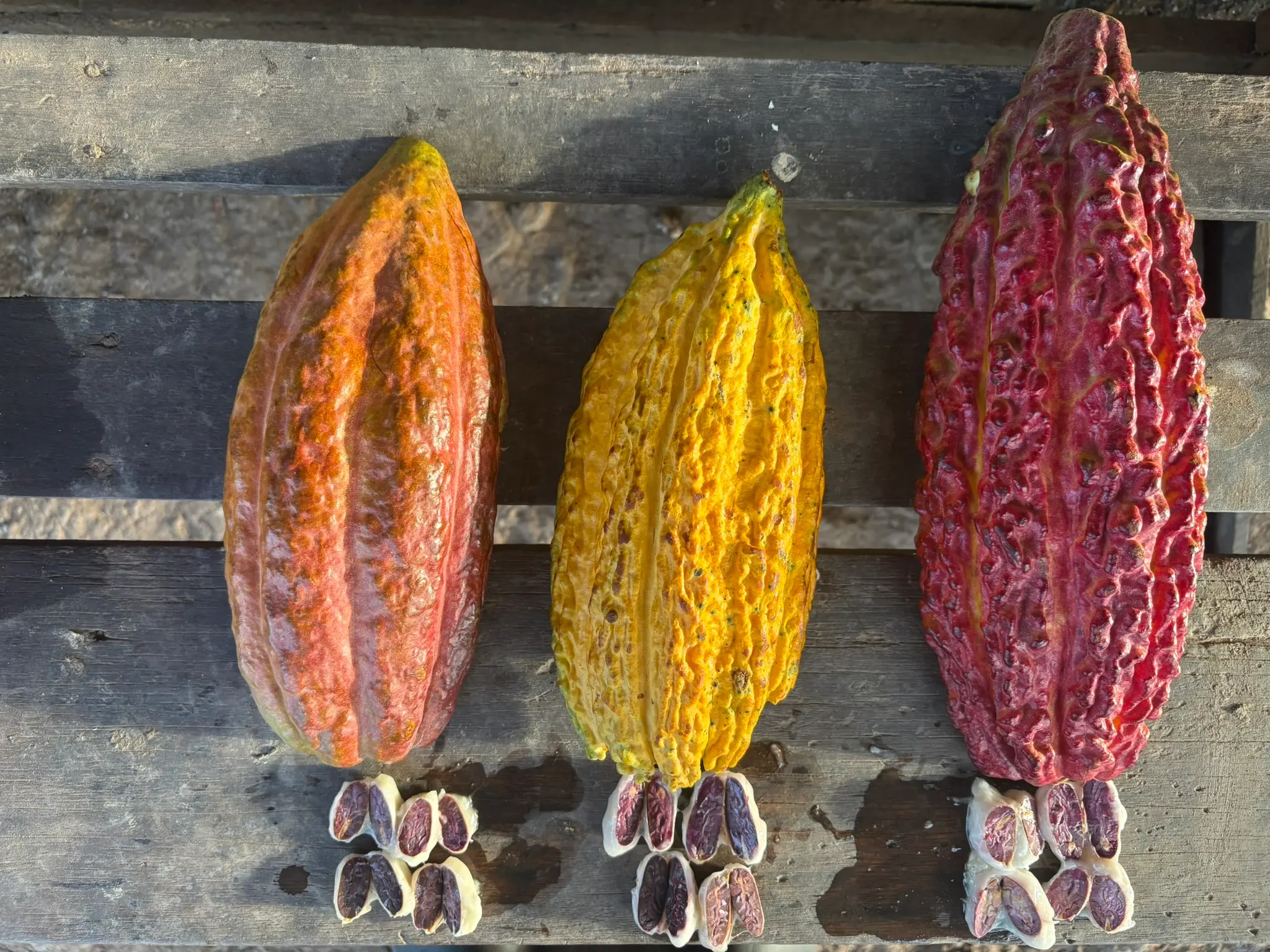
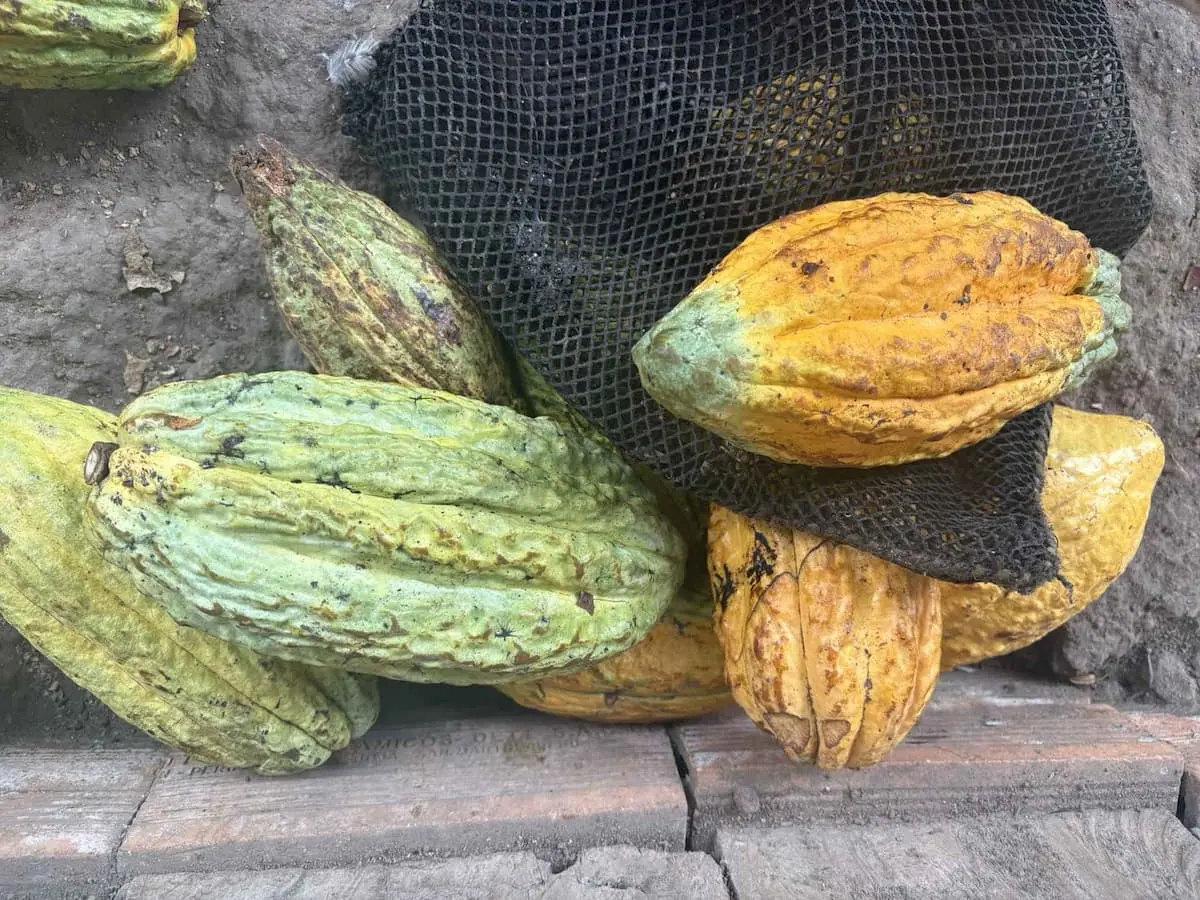
Here are some of the fine-flavor pods from our farm. You can tell varieties apart by the color, shape and roughness of the husk, the same traits catalogs use to identify each cacao.



The main groups, in a nutshell
A useful detail: in Peru, people often call any traditional local cacao “criollo”, even when it isn't genetically Criollo. That's why technical documents put the word in quotation marks.
New in 2026: four new lineages from Peru
In July 2026, researchers from the Universidad Nacional Toribio Rodríguez de Mendoza (Amazonas) and the University of the West Indies (Trinidad) analyzed the DNA of 390 native cacao trees from eight regions of Peru, San Martín included. They found four previously unknown lineages:
- Awajún: named after the Awajún communities of Amazonas.
- Porcelana: the white-bean cacao of Piura.
- Chuncho 1 and Chuncho 2: the native cacaos of Cusco and Ayacucho.
The study also showed that each region keeps its own genetic makeup, and that at least 13 of the 14 groups grow in Amazonas.
Peruvian cacaos with their own name
| Cacao · region | What makes it special |
|---|---|
| Blanco de PiuraPiura (Morropón, Huancabamba) | White beans, highly sought after by gourmet chocolate makers. Rescued since 2009, it is different from Venezuela's Porcelana Criollo and was recognized as its own lineage in 2026. There are already 8 clones yielding over 1,500 kg/ha with 100% white beans. |
| ChunchoCusco (La Convención) and VRAEM | An ancestral native race with pods in many shapes: elliptical, round or oblong. In 2026 it was identified as two lineages of its own. |
| Cacao Amazonas PerúBagua and Utcubamba (Amazonas) | Holds a designation of origin, and Amazonas is the region with the most native cacao lineages. From 136 promising trees, 10 clones were chosen for yield, health and flavor. |
| VRAE clones (CMP)VRAEM (Ayacucho and Cusco) | Agronomist Mendis Paredes evaluated 1,500 mother trees and kept the best 100 in clonal gardens. |
| Pangoa selectionsSatipo (Junín) | 13 elite trees chosen for yield (up to 3 t/ha), quality and pest tolerance. |
| Ucayali aromaticsNeshuya (Ucayali) | Aromatic clones from the Colpa de Loros cooperative, yielding over 1 t/ha, as an alternative to CCN-51. |
ICS-95 and CCN-51: two clones you'll hear about a lot
ICS-95 is a Trinitario clone selected in Trinidad (ICS stands for Imperial College Selection). CCN-51 was born in Ecuador and is one of its descendants: its pedigree is (IMC-67 × ICS-95) × an unknown Forastero.
CCN-51 became popular for its yield: in the Ministry of Agriculture catalog it produces about 2,760 kg/ha, among the highest. In 2008 it covered 84% of San Martín's cacao area. Since then, many cooperatives have gone back to aromatic cacaos, which are what fine chocolate makers ask for. Today San Martín is the country's top producing region: together with Junín, Ucayali, Huánuco and Cusco it accounts for 86% of Peru's cacao (Ministry of Agriculture, 2024).
💡 Two fun facts: the ICS-95 we grow at Fundo Maranatha is one of the “parents” of CCN-51. And according to the 2026 study, 45% of CCN-51's ancestry comes from the Peruvian Awajún lineage.
What's next: new varieties
Peru's agricultural research institute (INIA) keeps 342 cacao accessions in germplasm banks in Amazonas, Loreto and the VRAEM, and has already identified five that bear more pods of good weight. It hopes to use them to release new varieties with high yield, pest tolerance and good aroma.
Which cacao do we grow at Fundo Maranatha?
On our farm in San José de Sisa (San Martín), at 450–600 m altitude, we grow fine-flavor Criollo/hybrid and ICS-95, plus a conventional variety. Our products are an artisan blend of all three, fermented in wooden boxes and sun-dried on raised beds.

Taste San Martín cacao
Fermented, sun-dried cacao beans straight from the producer. Delivery in Lima and shipping across Peru.
Order on WhatsApp See all products →Want to know more? Read what fine flavor cacao is and why San Martín is Peru's cacao capital.
Sources
- García Carrión, L. F. (2010). Catálogo de cultivares de cacao del Perú. Ministry of Agriculture – DEVIDA. midagri.gob.pe
- Lastra, S. and Thomas, E. (eds.) (2022). Catálogo de cacaos del Perú. Alliance of Bioversity International and CIAT. cacaodiversity.org
- Motamayor, J. C. et al. (2008). Geographic and genetic population differentiation of the Amazonian chocolate tree (Theobroma cacao L.). PLoS ONE 3(10): e3311.
- Motilal, L. A., Calderón, M. S., Bustamante, D. E. et al. (2026). Genetic structure of traditional cacao reveals four new genetic lineages in indigenous Amazonian sites in Peru. PLoS ONE 21(7): e0351690. journals.plos.org
- Zarrillo, S. et al. (2018). The use and domestication of Theobroma cacao during the mid-Holocene in the upper Amazon. Nature Ecology & Evolution 2: 1879–1888.
- ICCO (2024). Revision of Annex “C” of the International Cocoa Agreement: fine or flavour cocoa exporters. icco.org
- Ministry of Agriculture of Peru (2024). Midagri impulsa cadena productiva del cacao. Andina news agency, 18 July 2024. andina.pe
- INIA conserva la calidad genética de 342 accesiones de cacao. Agraria.pe, 2 October 2025. agraria.pe
Keep reading